| Characteristics | Description | |
|---|---|---|
| C1 | System under study | A Styrofoam box containing a lid, a heating element, and fan, controlled by a Raspberry Pi, for incubating tempeh. |
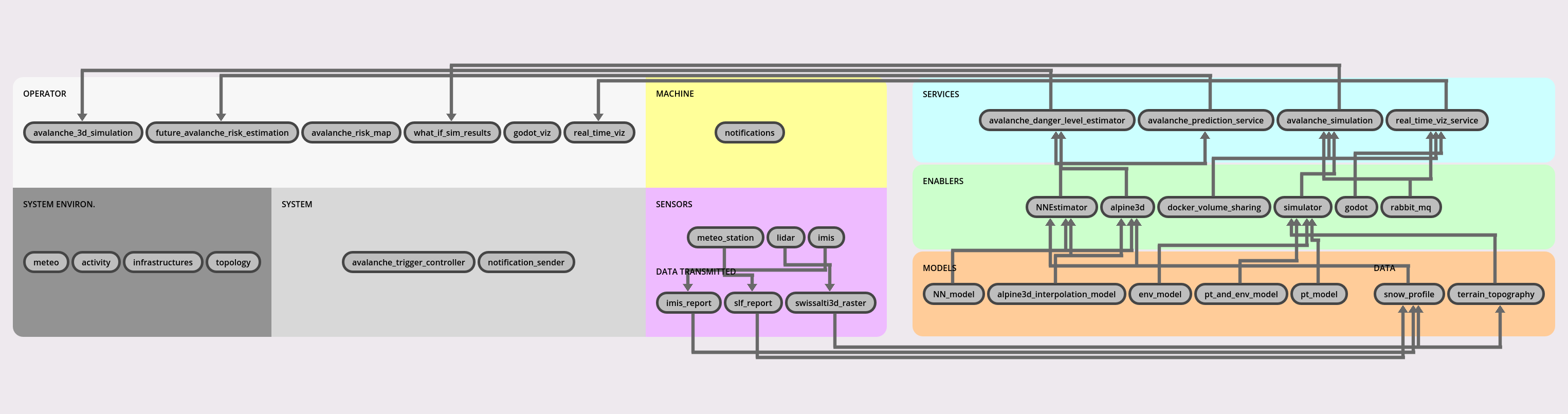
| C2 | Physical acting components | avalanche_trigger_controller: Controls the avalanche triggers grid notification_sender: Controls sending of notifications to users |
| C3 | Physical sensing components | meteo_station lidar imis |
| C4 | Physical-to-virtual interaction | imis_report slf_report swissalti3d_raster |
| C5 | Virtual-to-physical interaction | The DT sends notifications to emergencies services and users. |
| C6 | DT services | avalanche_danger_level_estimator avalanche_prediction_service avalanche_simulation real_time_viz_service |
| C7 | Twinning time-scale | Slower than real-time Real-time The DT-to-PT occurs at the timescale of days, as the PT sends weather and snow updates to the DT. Faster than real-time Immutable |
| C8 | Multiplicities | The current implementation has no multiplicities, however, it is possible to deploy for free multiple DTs for multiple mountains. |
| C9 | Life-cycle stages | The DT only supports the service phase. In the service phase, it supports executing and analyzing. |
| C10 | DT models and data | Model: NN_model alpine3d_interpolation_model env_model pt_and_env_model pt_model Data: snow_profile terrain_topography |
| C11 | Tooling and enablers | NNEstimator alpine3d docker_volume_sharing simulator godot rabbit_mq |
| C12 | DT constellation | The orchestration of the system-as-a-whole is carried out by (micro-)services. These services operate on their own depending on the availability of data. They include weather simulation, prediction, and enablers. Yet it is not possible to leave aside some of the micro-services. |
| C13 | Twinning process and DT evolution | The DT was engineered based on flexible requirements, with an MVP consisting of avalanche danger prediction. |
| C14 | Fidelity and validity considerations | The DT is yet to be validated against historical data for accuracy. |
| C15 | DT technical connection | The PT-to-DT connection is done over Ethernet using RESTful APIs |
| C16 | DT hosting/deployment | The Incubator DT is deployed on a virtual network, which can be deployed on a VPS. |
| C17 | Insights and decision making | avalanche_3d_simulation: simulation of the impacts of an avalanche in a specific area future_avalanche_risk_estimation: estimation of the avalanche risk avalanche_risk_map: avalanche_risk_map visualization of the current state and historical data what_if_sim_results: what-if analysis of potential avalanches in risky zones godot_viz notifications real_time_viz: 3D visualization of the Alps |
| C18 | Horizontal integration | There is horizontal integration with the services of the Swiss Alps DT. The DT is able to exchange information with other information systems via volume sharing and message passing using RabbitMQ. |
| C19 | Data ownership and privacy | Datasets are the exclusive property of SLF and other governmental oranisations. No privacy-related data is stored. |
| C20 | Standardization | Communication is carried out using AMQP standard via RabbitMQ. |
| C21 | Security and safety considerations | Communication can be TLS encrypted through the RabbitMQ broker. All actions performed by the DT need human action for now. |